

About Course

THE PROGRAM AT A GLANCE
| Recommended duration | 4 semesters full-time |
|---|---|
| Applied learning | Supervised case review |
| Culminating experience | Capstone and supervised externship |
A WHOLE-PERSON PERSPECTIVE
Understand the connections.
See the bigger picture.
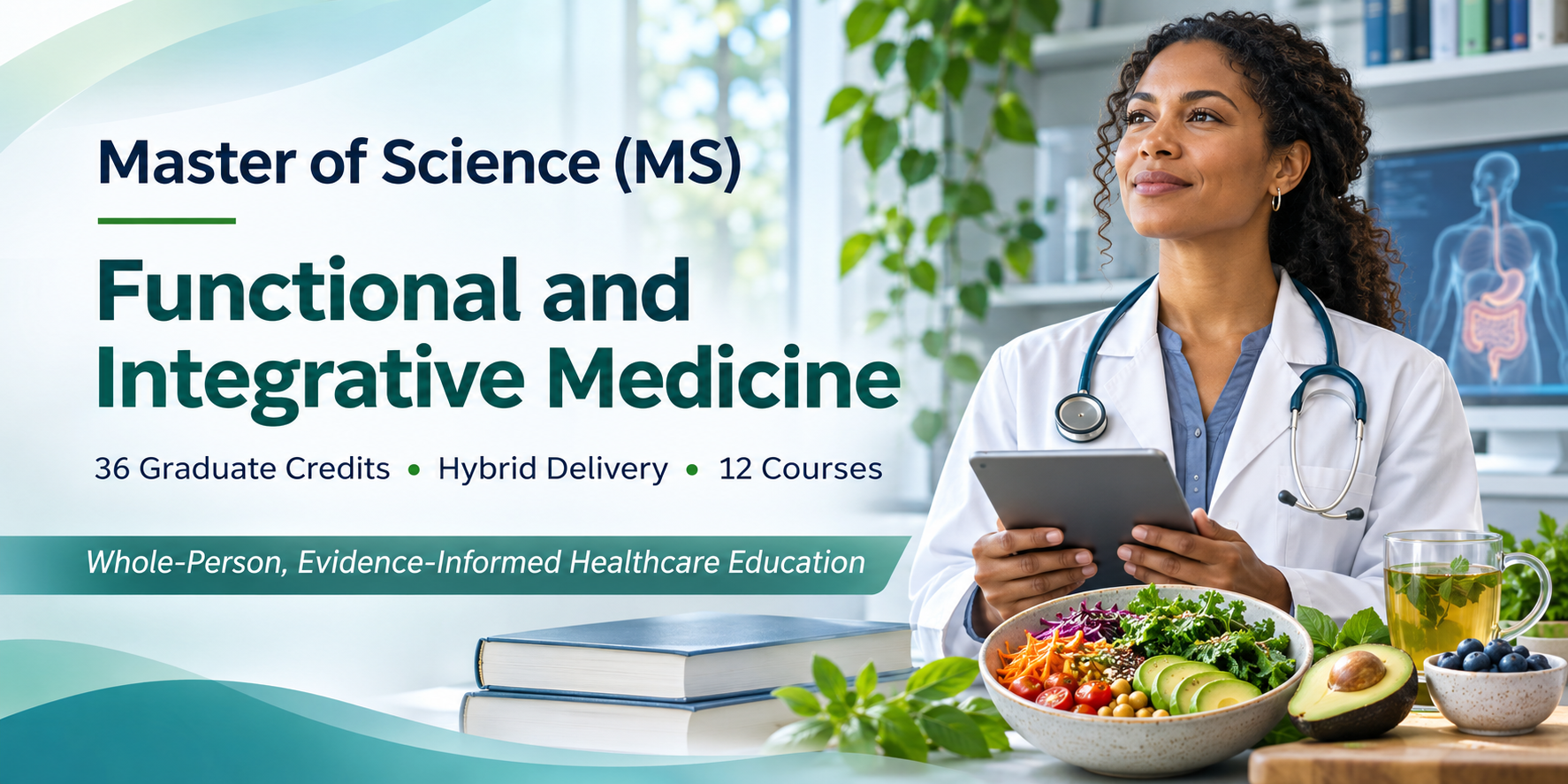
The Master of Science in Functional and Integrative Medicine prepares health professionals and qualified graduate students to evaluate chronic and complex health concerns through a whole-person, systems-biology framework.
Connect nutrition, lifestyle medicine, microbiome science, immune regulation, cardiometabolic health, laboratory interpretation, and integrative case management. Learn to weigh the evidence, recognize limitations, and design individualized strategies that respect patient priorities and professional boundaries.
A CONNECTED FRAMEWORK
Three perspectives. One person.
BIOLOGY
Immune function · metabolism · microbiome
LIFESTYLE
Nutrition · sleep · movement · stress
CONTEXT
Environment · relationships · patient values
YOUR LEARNING OUTCOMES
Build knowledge you can apply.
01 Connect the systems
Analyze complex health histories using a whole-person, systems-based framework.
02 Interpret in context
Interpret nutritional, lifestyle, psychosocial, environmental, and laboratory information in context.
03 Personalize responsibly
Develop individualized, evidence-informed care plans within your professional scope.
04 Evaluate the evidence
Critically appraise research and distinguish established evidence from emerging, unsupported, or potentially unsafe interventions.
05 Collaborate with clarity
Communicate clearly with patients, families, and interprofessional teams, including appropriate referral.
06 Apply your learning
Demonstrate graduate-level reasoning through case analysis, research appraisal, and a capstone project.
THE CURRICULUM
Twelve courses.
A deeper view of health.
Explore four connected themes below. These groupings introduce the curriculum; they are not a semester schedule.


THE LEARNING EXPERIENCE
From understanding to application.
01 Explore
Build foundations in systems biology and whole-person care.
02 Evaluate
Appraise research, clinical information, and intervention safety.
03 Integrate
Apply learning through supervised case review and individualized planning.
04 Demonstrate
Complete your capstone presentation and supervised externship requirements.
Your capstone may be a clinical case analysis, literature review, quality-improvement proposal, practice model, patient education program, research proposal, or applied integrative medicine project.
THE RESEARCH DESK
Start with better questions.
Use these public resources to explore evidence and strengthen your research literacy.
RESOURCE 01
PubMed
Search biomedical literature and follow citations to original research.
RESOURCE 02
NCCIH Health Information
Explore evidence summaries, complementary health topics, and safety information.
RESOURCE 03
ClinicalTrials.gov
Learn how clinical studies are designed and how trials differ from observational research.
RESOURCE 04
MedlinePlus
Read a plain-language introduction to clinical trials and find related research resources.
Optional external resources; separate from the institution’s required readings. Links do not imply endorsement of this program.
ADMISSIONS
Who this program is for
Health professionals and qualified graduates seeking advanced study in functional and integrative medicine. Preferred backgrounds include health sciences, medicine, nutrition, biology, psychology, nursing, pharmacy, chiropractic, naturopathic medicine, public health, and allied health.
Entry requirement: A bachelor’s degree from an accredited institution. Prior coursework in anatomy and physiology, biology, or health science is recommended.
ASSESSMENT
A balanced assessment approach.
Quizzes 25%
Midterm examination 30%
Class attendance and participation 10%
Project presentation / capstone 10%
Externship 25%
GRADUATION REQUIREMENTS
Completing your degree
- Complete 36 graduate credits.
- Earn a minimum grade of B, or the institutional equivalent, in all core courses.
- Successfully complete case-based assessments and research appraisal assignments.
- Complete and present or orally defend your capstone project.
- Complete the required supervised externship hours.
SCIENCE · LIFESTYLE · WHOLE-PERSON CARE
Bring curiosity.
Build understanding.
Practice thoughtfully.
Develop a research-literate approach to complex health concerns through individualized care, interdisciplinary collaboration, and ethical practice.
Professional scope and licensure
Completion of this program does not confer medical licensure, prescribing authority, diagnostic authority, or authorization to practice outside your existing professional license, certification, or jurisdictional scope of practice. Students and graduates must comply with applicable laws, regulations, and professional standards.
Photography illustrates the field of study and does not depict program faculty, facilities, or placements.
Course Content
Topic 4 — Clinical Nutrition and Nutritional Therapeutics
-
00:00
Topic 3 — Root Causes of Chronic Diseases and Integrative Solutions
Topic 2 — Digestive Health, Microbiome, and Functional Gastroenterology
Topic 4 — Clinical Nutrition and Nutritional Therapeutics
Topic 5 — Lifestyle Medicine, Mind-Body Medicine, and Spiritual Health
Topic 6 — Immunology, Inflammation, and Immune Modulation
Topic 7 — Cardiometabolic and Longevity Medicine
Topic 8 — Complementary and Traditional Medicine
Topic 9 — Women’s Health and Pediatric Functional Medicine
Topic 10 — Functional Laboratory Testing and Clinical Diagnostics
Topic 11 — Regenerative Medicine and Cellular Therapies
Topic 12 — Integrative Therapeutics, Research Methods, Clinical Case Management, and Capstone Project
Student Ratings & Reviews

No Review Yet